IB Physics Theme D: Fields – Gravitational, Electric and Magnetic
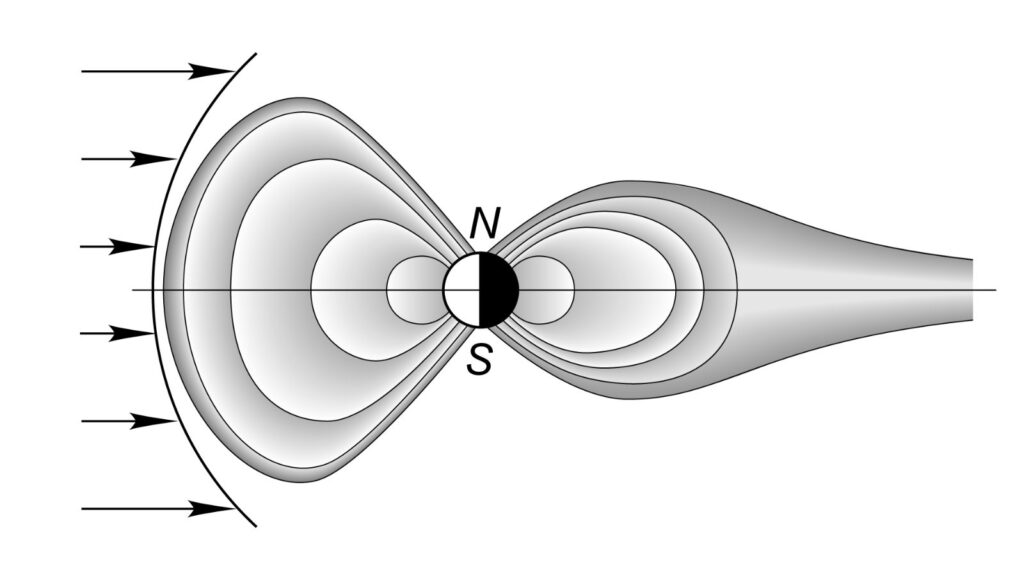
Theme D, Fields, is where IB Physics becomes most abstract and most rewarding. It describes how masses and charges influence each other at a distance through gravitational, electric and magnetic fields, and, at HL, how changing magnetic fields produce electricity. It underpins satellites, particle accelerators, motors and generators. This guide summarises the topics and the approaches that help students master them.
What Theme D covers
| Topic | Level | Key ideas |
|---|---|---|
| D.1 Gravitational fields | SL and HL (extended at HL) | Newton’s law of gravitation, field strength, Kepler’s third law, orbits; at HL, potential, escape speed and orbital energy |
| D.2 Electric and magnetic fields | SL and HL (extended at HL) | Coulomb’s law, electric field strength, field lines, magnetic fields of currents; at HL, electric potential and equipotentials |
| D.3 Motion in electromagnetic fields | SL and HL | Forces on charges and current-carrying wires, circular motion of charged particles |
| D.4 Induction | HL only | Magnetic flux, Faraday’s and Lenz’s laws, generators and alternating current |
One idea, three fields
Gravitational and electric fields follow the same structure: an inverse-square force law, a field strength defined as force per unit mass or charge, and (at HL) potential defined as energy per unit mass or charge. Build a comparison table of the two. Seeing the parallels halves the amount you need to learn and helps in “compare” questions.
Gravitational fields and orbits
- For circular orbits, set the gravitational force equal to the centripetal force; this gives orbital speed and period.
- Kepler’s third law (T² ∝ r³) follows from the same equation.
- At HL, potential is negative and zero at infinity; escape speed comes from making total energy zero.
Electric and magnetic fields
Draw field lines carefully: they start on positive charges and end on negative ones, never cross, and are closer where the field is stronger. For magnetic fields around wires and solenoids, use the right-hand grip rule, and for forces on currents or moving charges use the appropriate hand rule consistently.
Charged particles in fields
A charge moving perpendicular to a uniform magnetic field moves in a circle, because the magnetic force is always perpendicular to its velocity. Setting qvB = mv²/r gives the radius. In an electric field, the force is along the field lines, so particles accelerate in a parabola, like a projectile.
HL: electromagnetic induction
An emf is induced when magnetic flux linkage changes. Faraday’s law gives its size; Lenz’s law gives its direction, opposing the change that caused it. Practise flux calculations, graphs of flux and emf against time, and the operation of generators and transformers.
Common mistakes
- Confusing field strength with potential.
- Using the wrong radius (from the surface instead of the centre) in gravitation.
- Mixing up hand rules or force directions for negative charges.
- Forgetting that magnetic forces do no work on moving charges.
How to revise Theme D
- Create the gravitational–electric comparison table.
- Practise vector diagrams for combined fields from several charges or masses.
- Do mixed questions linking D with A (circular motion) and B (circuits).
- Work through past and specimen papers for the current syllabus.
For applications, read 12 real-world electromagnetic field examples and our step-by-step guide to electromagnetic problems.
IB Physics theme guides: A: Space, time and motion · B: The particulate nature of matter · C: Waves · D: Fields · E: Nuclear and quantum physics
Frequently asked questions
Is induction on the SL syllabus?
No. D.4 induction is HL only.
Why are gravitational potentials negative?
Potential is defined as zero at infinity, and work must be done to move a mass away from another mass, so potential at finite distances is negative.
How do I find the radius of a charged particle in a magnetic field?
Equate the magnetic force to the centripetal force: qvB = mv²/r, so r = mv / qB.
Turn this into a 7 in IB Physics
- 200+ IB tutors & examiners
- Lessons in your time zone
- Free consultation first